We are living in the times when at least half of the LinkedIn users1, AI-influencers, or people you barely know are telling you to get out of your comfort zone, before you have had enough time to spend in and enjoy your “comfort zone” (i.e. doing what you know best – apparently it is “not cool” anymore :/). Every day. Perform perform perform. Yet again, I decided to get out of my comfort zone by accepting to be part of the AI-Write project – focusing on two things I knew little about (from a research perspective): “Artificial Intelligence (AI)” and “writing”. You know what? I am very happy that I did it. Fasten your seat belts. I will tell you why.
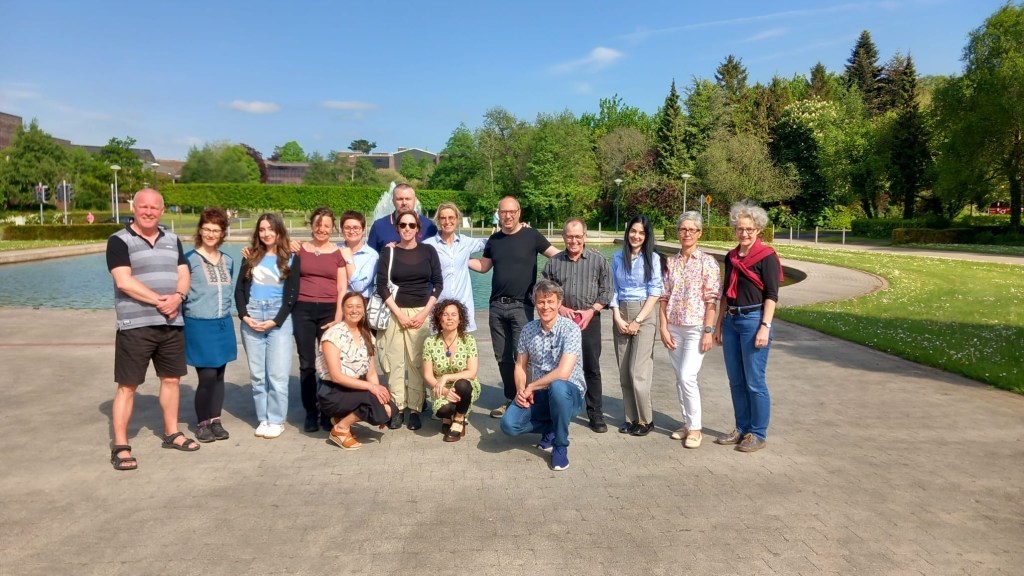
I am writing this post from my hotel room in Limerick, Ireland (and in less than 4 hours, at 06:00 am, I will start my journey to go back home, to Västerås). We have completed, today, the third work package (led by the University of Limerick) of the AI-Write project, which is an “Erasmus+ funded project that aims to revolutionise the landscape of academic writing in English through the development of innovative approaches and supporting materials that leverage AI tools2“. No pressure. Today, we had an event during which we showcased the first drafts of our Open Educational Resources (OERs), designed to assist students, teachers, teacher educators, and researchers (and we had an amazing plenary by Prof Mark Warschauer, University of California). The OERs we designed are on (1) AI literacy and data privacy, (2) prompt engineering, (3) pedagogy, reflection, and assessment, (4) planning and drafting, and (5) revising and editing. These are multimodal resources, lesson plans, info-graphics, videos (and whatnot) that are designed to help students and teachers. The OERs were designed by dedicated teachers/researchers/teacher educators from the University of Hildesheim (Germany), University of Limerick (Ireland), University of Antwerp (Belgium), Mälardalen University (Sweden), and the University of Innsbruck (Austria). They are being piloted, they will be tested, they will be disseminated. They are designed by the awesome people (see the picture below 😉 ) in the project, who I am happy to call colleagues and friends now; who care, and are curious, and are good educators who know their contexts well, and who do want to do something, together, collaboratively, beyond their universities, cities, countries (the longest sentence ever). We know now (better) the differences between our (institutional) contexts, but we also love our similarities. One thing we all agree(d) on today: WE LOVE LIMERICK!
Maybe it is the Irish hospitality, our amazing hosts, Guinness, nature, or the campus full of students who enjoy where they are (confession: we have to work on that in Västerås and Eskilstuna). The “human” connection with “the space” is what you immediately notice, appreciate, and fall in love with at Limerick University- on campus. And then you realize the things you might lose when the effect, the role, the say, the spirit of us, the humans, diminish from anything we do – including “writing”. We love writing. It is one of the most human and the most creative things that we have ever done. And now we have decided that we will let some of that power go by collaborating with AI: “sharing the agency”. But wait a minute. Are we sharing a cake – so AI takes a part of the cake and we take the other part?. Why should it be 1.0 cake? When we collaborate, with AI, maybe the cake gets bigger? And you see the parts of the universe that was not possible to see before? (Personal opinion: with AI, I am more optimistic; with LLMs, a bit less optimistic).
Anyhow. This post is supposed to be about our project 🙂 But also, as I promised in the title, about the future of higher education (in Europe). With our AI-Write project, we took a bold step and created open educational resources for teachers and students, aiming to provide them with resources that can support the ways they think, argue, write, edit, revise, present, publish. We wanted to do this by standing on the shoulders of giants: which means we (wanted to) benefit from decades of research findings based on learning sciences, pedagogy, didactics, second language acquisition (SLA), applied linguistics, and TESOL. We will do our best to reach the goal we promised that we would reach. And this brings us to the final part of this so far relatively boring (but come o:::n, kind of engaging) text. The future of higher education (in Europe).
It is possibly quite obvious for our partners in Austria, Germany, Ireland, and Belgium: EU projects are (extremely) valuable as they provide the platform for bringing together and developing skills and competencies from multiple cultures, but also for facilitating global citizenship. In Sweden, however, some universities have gone through a period in the past when EU projects were not supported, encouraged, and appreciated enough (money money money). I am happy to say that there is a wind of change – but we need to make sure that the wind blows. We need each other more than we ever did, not just because AI is out there now and is making us question what is it that is “human” in everything we do in higher education. What went wrong in the ways we do “science communication” within academia that so many people are panicking due to what they call “disturbance” or “distraction” by AI? (i.e. all those research articles that we write for each other and then give to a publisher for free so that they can sell it back to our university, with all those peer reviews by our colleagues who spend 10 hours doing a nasty review the time of which is paid by their employers, which, in most of the cases, pay them through the taxes of the people who live in the country where the universities they work at and for are located in)?3 . We need to remember, collectively, in Europe and elsewhere, that higher education is Higher EDUCATION! The education we design and deliver should be of highest standards, innovative, inspiring, research-based, futuristic, exciting, original, authentic. No pressure (!). AI-Write is an attempt towards this direction and towards the realities of higher education in the future in which “education, research, and collaboration” are intertwined. If we want to design the future of higher education in the world with humans at the center, we need to combine these three pillars (i.e. education, research, and collaboration) with internationalization, with collaboration projects between institutions from different countries, with engagement between researchers and practitioners. We do need to blend human creativity with new understandings of intelligence (see hybrid intelligence).
To make this possible, and to make sure that higher education plays a central role in facilitating human well-being, development, and equity, we do (maybe) need to get sometimes out of our comfort zones, but also use what we know best already. To transfer this developing knowledge to other people and to the next generation, WE HAVE TO WRITE! How we write, OUR control on what we write, and to whom we write shall still stay as the central capital of human hybrid intelligence. We need to learn from the Irish creativity, hospitality, positivity, and develop a humanistic way to approach technology. We will need to write about it. Our project, AI-Write, is a step forward.
Olcay Sert
2 May, 2025
Limerick
1. The other half is busy to be “thrilled(!) to announce that” they have a new Qx publication or something.
2. https://www.uni-hildesheim.de/aiwrite/
3. ok, this might be the longest sentence ever.
 Olcay Sert