Opening commentary: A practice-based writing workshop run by Laura Watts
On the 3rd of June, 2026, I attended a practice-based writing workshop led by Laura Watts and organised by David Redmalm at Mälardalen University. The only preparation needed was to bring three objects related to my research to write about. The task was to produce experimental pieces of writing inspired by the objects brought to the workshop. I knew what my objects were going to be. I knew that I needed this workshop without knowing about it beforehand. I have been going through hard times at work- and even the times left for my academic writing have not been fun recently. Chasing deadlines, dry writing, without my soul in it. This had to stop. This workshop was going to give me a few hours to write in the ways that I missed to write. And it did. I felt alive.
I was lucky to be in the same room with amazing colleagues. Following Laura’s instructions, we wrote, we read what we wrote to each other, we talked about each piece, we laughed, got moved, and even almost cried. Yes, you heard it right. Writing about our research! We felt that we were humans, once again. When I read that we needed to bring three objects about our research, I knew without thinking what I would take with me:
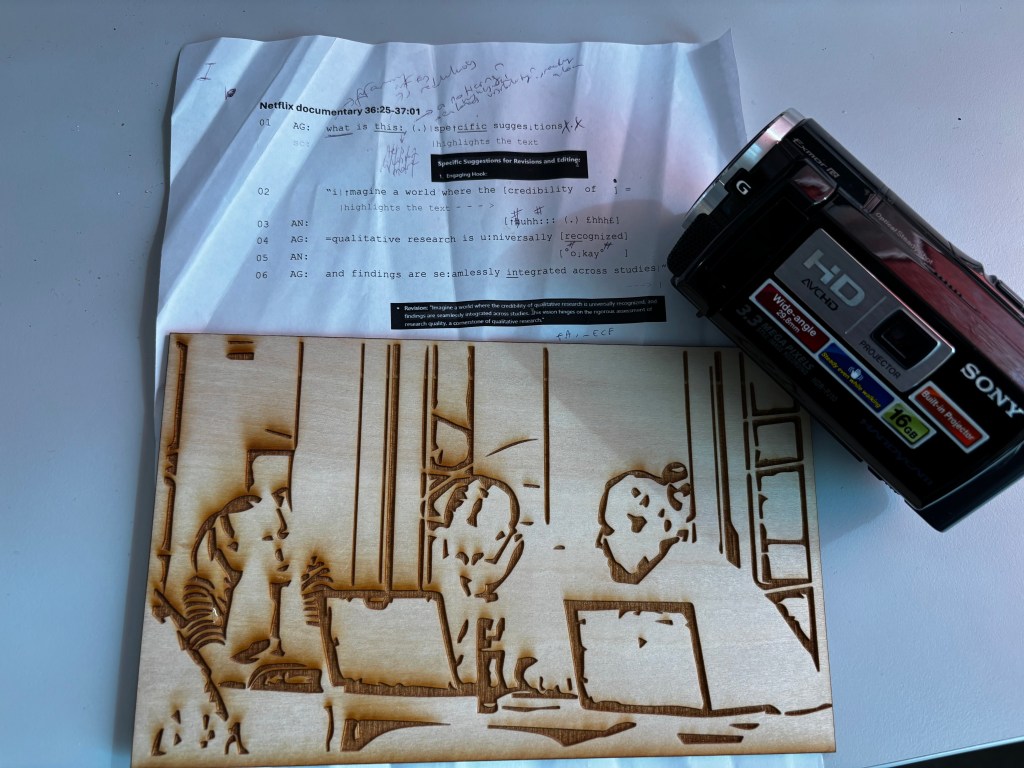
-My first object was a video camera that I have been using to collect data from and capture interactions in classrooms.
-My second object was a transcription that I used for a data session at Teachers College in New York.
-My third object was an anonymised screenshot based on a recent article, produced using a digital laser cutter.
I am going to share with you three pieces of experimental writing. I had around 40 minutes to write these pieces. Just writing. No time to edit, check grammar, or vocabulary. Pure, good old writing. A journey was the theme of the first writing. How do we use the three objects from our research to depict a journey? My fingers were on fire. I felt creative, again! Now look at the objects in the picture. I hope you see what I see. If you know me, imagine my voice as you read.
Capturing journeys of learning – to infinity.
Standing on a tripod, waiting for the recording button to be pushed. I can almost see the traces of my fingerprints on this camera: hundreds of hours of recordings made in spaces where learning takes place. It is beyond just a tool, beyond a recorder, beyond a data collection instrument. The camera captures moments of joy, boredom, engagement, motivation, unwillingness, relationships, teaching, and learning – as it happens, second after second. This is where the journey begins. Those lives and moments get captured, but they are only imprisoned before I, the researcher, the writer, start writing this journey through the horse glasses my methods provide me with. Don’t get me wrong, the horse glasses can come in handy – they still enable me to see things when I dig into trying to understand the motion captured in the camera. Take, for example, three students, sitting together, discussing the material they have been given by the teacher. They lean forward, they look at each other, at the screen of their computers, at the printed document on their desks. How can I tell their story to other people? I need to freeze the time I captured – freeze their lives as it is visible on my computer. I need to transcribe this – every little detail, milliseconds, the intonation, silences…But wait a minute, they look at each other sometimes – I need to capture their gaze, gestures, hand movements in the transcription. This is getting harder. My eyes and my ears help me a lot to understand what they are doing and why they are doing it, surprisingly both despite and with the help of my horse glasses. I need to capture their journey towards learning so that I can tell everyone about this miracle: they work together, learn from each other, develop ideas, argue, counter-argue. This is magic. I captured every little detail of their learning journey. If I write this up, using the correct transcriptions, correct images, maybe their learning journey will be other people’s learning journey too. The journey of students’ learning, together, captured, transformed, translated, represented in writing. The prisoners of the camera are now freed – they are captured in writing and in printed images. But wait a minute. What if they got into a new prison now? One that I built? The only way to free the learning journey is to spread the word. And the journey will continue in other people’s lives. It will be multiplied. Reborn. Will not disappear.
Midway commentary
I am not sure if mid-way commentary is a thing, but here we are, now it is. When I read the text I wrote to my colleagues in the room, I felt so emotional. I was almost about to cry. I really enjoyed it when they talked about my text. This is awesome. Why don’t we do it for every piece we write? Why don’t we take the time and read to each other? It does not matter what kind of writing it is. It just needs to be read aloud to come alive, I think. Or does this only work with this kind of experimental writing?
Before I move on to the other pieces, well, you know the elephant in the room. Horse glasses – please excuse my Turkish. Of course I meant blinkers. I still like horse glasses better though.
Our second task was to explore “Point of view”. You know it, right? (I did not): first person, when the reader looks through the narrator’s eyes; second person, when the narrator directs the reader’s view; and third person, when the reader is detached from the narrator’s view. We were asked to write the same thing using two perspectives. In 20 minutes! The theme was still “a journey”. I loved what came out. People even laughed after I read the first one aloud. Will it make the same impact when you read it? We will see.
Capture the learning journey!
Congratulations! You have just completed the first day of your fieldwork and data collection. You are now back in your office, transferring the video file to your computer: excited, curious, tired. You start watching the video, going through your field notes at the same time when you try to remember exactly what happened at that moment in the classroom. You watch the whole lesson with an open eye, taking notes as you watch, and as you listen. Those three students who were discussing enthusiastically after each task. You cannot take your eyes away from them. Good that you had an audio recorder in front of them, so that you can synchronise the video and the audio file to witness their learning journey captured by the camera and the audio recorder. This second task they completed. You know that they look so engaged – they take turns rapidly, look at each other, point at the computer screen, laughing, getting excited as they discuss. You see it in their body, you hear it in the tone of their voices, you have to do something about this now! You suddenly start transcribing using a Word file – no time to lose, no time for software. You start working on transcribing their talk first, but while replaying parts of the video, you cannot help but start taking screenshots, embedding them nicely into the transcription you are producing. Embedding embodied learning. You think about titles for research articles already. This is hard work. Slowly coming together, in snail pace, but you see so much, you want to write now! But not yet. You are patient. This is why you are good at this. Keep transcribing. You are going to tell everyone about this learning journey. You know that writing this up for a journal, getting it reviewed, getting it published will take ages. You know the pain. And you like it. You like the journey.
My journey of capturing students’ learning, as it happens
I was back in my office finally, dying to start watching the video I had recorded – this was such a fantastic lesson! I started playing and replaying the whole lesson, taking notes as if I were recording everything all over again, with the speed of my pen. Those three students at the back of the classroom – I had noticed while I was in the classroom already that they were doing a fantastic job. The video was shouting at me – focus on them! I synchronised the audio recording on their desk with the video file, and started digging in. Oh my god! They were so engaged, motivated, happily and positively loud. I started transcribing their second task interactions- so much was going on! How they navigated between the material and the computer screen. It was almost like watching an exciting movie – I could not leave the computer screen to get a glass of water. My mouth dry, I started transcribing what they said; every word they used during the discussion. They leaned forward, they used gestures, their facial expressions kept changing. I needed to capture all these details and embed the screenshots into my transcription. I had to embed embodied learning. Aha! Could this be the title of the first article I produce from this data? So little time for so much work. Publishing it. A dream, isn’t it? Is a painful dream called a nightmare? Such a nightmare to depict the learning journey of students. But I like it. I love it. This is why I am taking this journey.
Final commentary
The first one was probably written to a PhD student or to my younger self, or? No matter what, I enjoyed each second of this workshop. I wrote more than 1100 words in around 40 minutes, without getting distracted with other things. Using three objects. And thanks to Laura. And thanks to my colleagues in the room who shared their writing with me, who “listened to” my writing, and reacted wholeheartedly. We need more of this, we academics, smart asses, who sold their souls to dry pieces of writing. Not all the time. Not everyone. But you know what I mean.
Will I meet you again, in my writing?

